7 Creative Journaling Methods Beyond the Blank Page

If you’ve ever stared at a blank page and felt overwhelmed by the pressure to “write something meaningful,” you’re not alone. Many of us grew up thinking that journaling meant filling pages with paragraphs—but the truth is far more liberating. Your journal can be a space for whatever form of expression feels most authentic to you in that moment.
Creative journaling invites you to move beyond traditional writing and explore formats that might resonate more deeply with how you think and feel. When you answer Q Diary’s daily questions, trying different methods can unlock new layers of insight and make self-discovery feel less like a task and more like play.
Here are seven creative journaling methods worth exploring today.
1. Mind Mapping Your Thoughts
Instead of writing linearly, try capturing your thoughts as branches radiating from a central idea. Write a main theme or emotion in the middle, then let related thoughts, observations, and questions branch outward naturally. This approach helps you see connections you might miss in traditional writing.
When you encounter a question like “What’s weighing on my mind right now?”, you could place that at the center and let the branches capture the different angles—the practical concerns, the emotional undercurrents, physical sensations, and potential solutions all at once. It’s simultaneously holistic and organized.

Make Mind Maps Visual
Use different colored pens for each branch or theme. The visual element helps your brain process and retain the information better, and it makes your journal more enjoyable to revisit later.
2. Collage and Visual Expression
Some of life’s biggest feelings are hard to capture in words. Instead, try cutting images from magazines, printing photos, or sketching simple illustrations that represent your emotions, dreams, or observations. There’s no artistic skill required—only honesty about what resonates with you.
This method works beautifully for questions about your aspirations or how you’re feeling in ways you can’t quite articulate. A single image can hold more nuance and depth than a paragraph of explanation.
Create a Vision Collage
For questions about your future or goals, gather images that inspire you and arrange them on a page. Rather than writing about what you want to achieve, let these visuals speak for you. It creates a more vivid, emotionally resonant record that you can return to for inspiration.
3. Poetry as Emotional Shorthand
Who decided that journals had to be written in prose? Try responding to Q Diary’s questions with short poems, haiku, or simply rhythmic language that captures the essence of your day or thought. Forget about perfect rhyme schemes or grammar—this is about finding the poetic truth in ordinary moments.
For example, instead of writing about a difficult conversation, you might write:
Your words landed hard
I held my ground, barely
Tonight, I breathe slow
Poetry has a way of distilling complex feelings into their truest form. It demands you choose words carefully, which often leads to deeper clarity about what you actually feel.
4. Dialogue with Yourself
Try writing your journal entries as conversations. Ask yourself a question and let different parts of you answer. Your rational mind might have one perspective, while your emotional heart has another. Q Diary’s questions become prompts for these internal dialogues.
You might write: “Me: Why did that bother me? Inner voice: Because you wanted to be understood. Logical self: But they weren’t trying to hurt you. Me: I know, and that’s what’s frustrating.”
This format honors the fact that we contain multitudes—we’re not just one voice with one opinion.
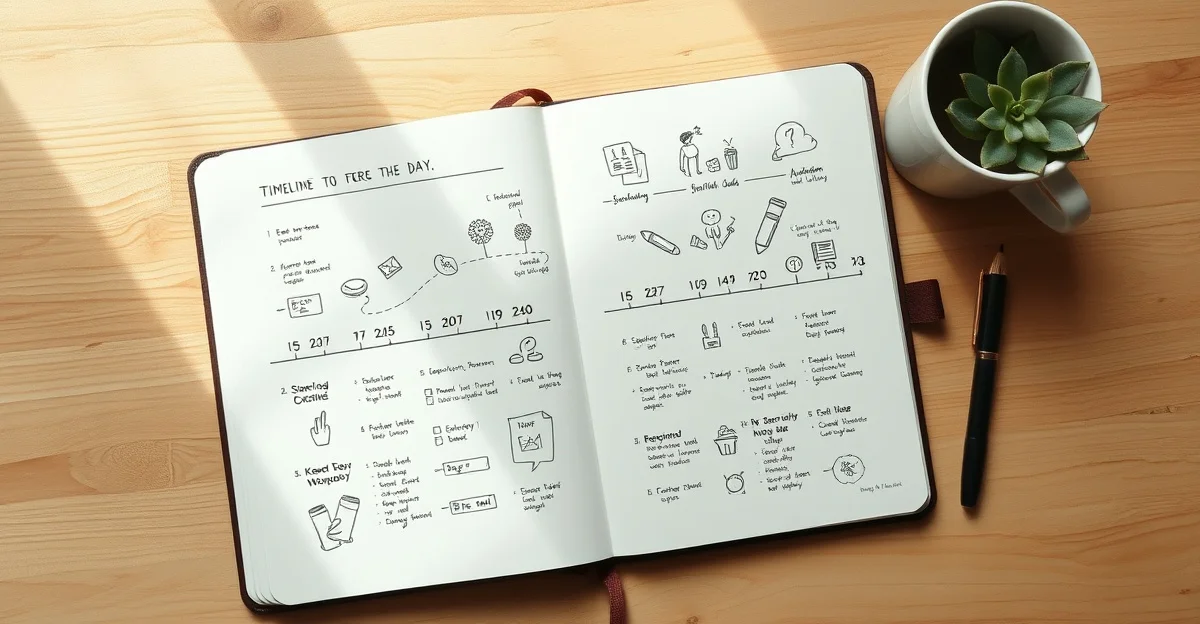
5. Timeline and Emotional Mapping
Sketch out your day as a timeline. Mark significant moments with icons, doodles, or brief notes. Then, add a curve above or below the timeline to show how your emotional state shifted throughout the day. Where were the peaks? The valleys? What surprised you?
This visual approach reveals patterns you might otherwise miss—maybe you always feel a dip after lunch, or a particular conversation lifts your mood in ways you hadn’t consciously registered.

The Emotional Curve
Adding a simple line that rises and falls to show your emotional state throughout the day is remarkably revealing. You can see at a glance when things shifted and why. It’s objective in a way that pure reflection sometimes isn’t.
6. Lists and Categorical Thinking
If linear narratives feel forced, embrace the power of lists. Create themed lists in response to Q Diary’s questions: “Five things I’m grateful for today,” “Moments when I felt alive,” “Questions I want to explore,” or “Small wins this week.” You can make these lists poetic, playful, or purely functional—whatever serves you.
Lists are underrated as a journaling format. They’re efficient, honest, and easy to scan later. They also remove the pressure to craft perfect sentences.
7. Voice Memos Transformed
On busy days, record your thoughts using your phone’s voice memo app, then transcribe key phrases or the most resonant moments into your journal. You capture the raw authenticity of spoken thought without the time commitment of writing everything out.
Alternatively, listen back to your recording and write a brief summary, or simply paste selected quotes from the transcript. This hybrid approach honors the reality of your life—sometimes you’re too busy to journal traditionally, but you still want to capture what matters.
Finding Your Creative Method
The beauty of creative journaling is that there’s no single “right way.” Your journal is entirely yours—a space to experiment without judgment. Some days you’ll feel like writing paragraphs. Other days, a quick list or a sketch will feel more true.
Start Small
Don’t try all seven methods at once. Pick one that intrigues you and commit to using it for a week alongside Q Diary’s daily questions. Notice how it changes what you discover about yourself. Then try another method next week. Journaling is a form of play, not performance.
The real gift of trying different journaling methods is discovering how each one unlocks different parts of your thinking. Your mind might work in words, images, rhythms, or diagrams—or probably some combination of all of these. By giving yourself permission to journal creatively, you’re not just changing the format—you’re deepening your relationship with yourself.
Q Diary’s 366 thoughtful questions are waiting for whatever form of expression feels most honest to you today. That freedom, itself, is the whole point.