Keeping Your Journal Private and Secure

Your journal is where you tell the truth—to yourself, without filters. It holds the moments you don’t share, the feelings you’re still processing, the dreams you’re testing out, the doubts you’re wrestling with. This honesty is sacred. And protecting it isn’t about hiding secrets; it’s about creating the safe space you need to truly know yourself.
Whether you write on paper or type on a screen, your journal deserves protection. When your journaling feels secure, you can be more vulnerable. You can ask harder questions. You can write the thoughts you’d never say aloud.
Why Journal Privacy Matters

Think about the last time you felt watched while writing. Chances are, you held back. You softened your words. You edited yourself before the pen even touched the page.
This is a real psychological phenomenon. When we believe our words might be read, we unconsciously censor ourselves. We write what we think we should feel, not what we actually feel. We craft narratives instead of exploring truth.
The Safety-Honesty Connection
Research in expressive writing shows that people are more likely to achieve genuine self-insight when they feel their writing is truly private. A protected journal becomes a space where real growth can happen.
Journal privacy isn’t about shame or secrets. It’s about permission—permission to be messy, contradictory, uncertain, and fully human on the page. It’s the foundation that allows deeper self-discovery.
Securing Your Physical Journal
If you keep a paper journal, protection is straightforward but worth doing intentionally.
Choose your storage wisely. Find a spot that’s not the first place someone would look. A shelf behind other books, a drawer with a lock, a box under the bed—somewhere that signals, “This is private.” The goal isn’t Fort Knox security; it’s a reasonable barrier that respects your space.
Consider a locked journal. Many beautiful journals come with small locks or clasps. If you live with family or roommates, this simple tool sends a clear message: this belongs to me.
Be direct about boundaries. If privacy is a concern in your household, have a conversation. “My journal is personal and off-limits” is a complete sentence. Most people will respect this if you state it clearly.
Use a simple cipher if needed. Some people use a basic code for the most sensitive passages—not for perfect encryption, but as a small extra layer that makes accidental discovery less likely.
Protecting Your Digital Journal
Digital journaling offers convenience, searchability, and the ability to look back across years. But it requires more intentional security.
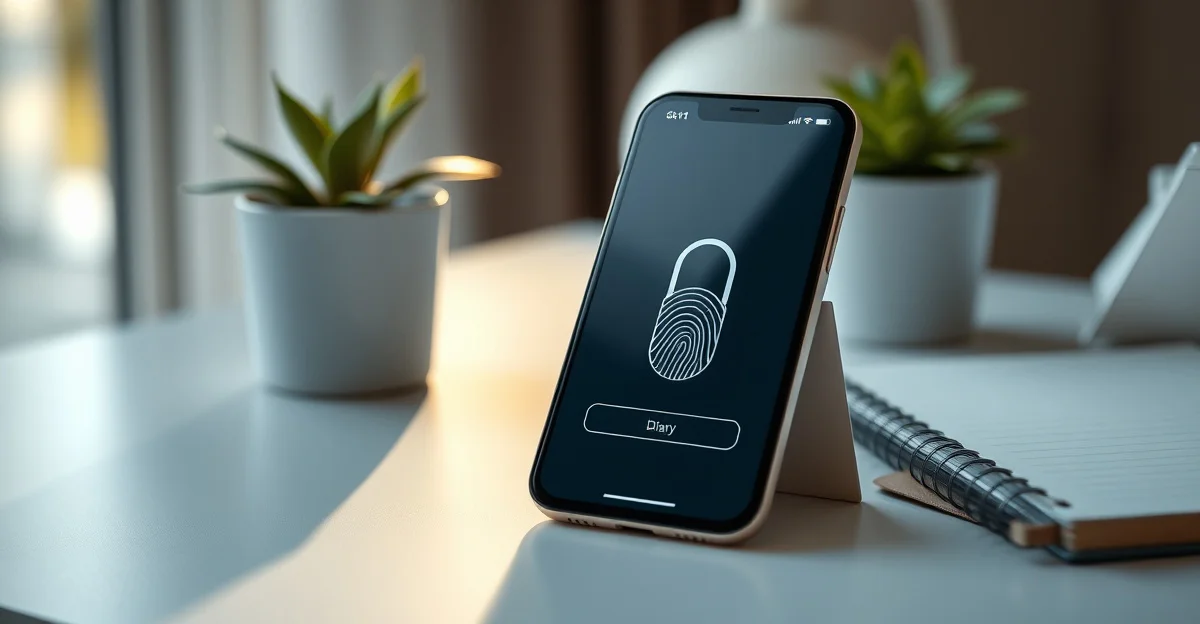
Set a strong password. Use a combination of uppercase, lowercase, numbers, and symbols. Avoid birthdays, names, or predictable patterns. If the app offers biometric login—fingerprint or face recognition—use it alongside or instead of a password.
Enable app-level security. Many journaling apps, including Q Diary, let you set a PIN or biometric requirement before opening. Activate this. It’s your first line of defense if your phone is borrowed or lost.
Secure your device itself. Don’t rely only on app passwords. Your phone or tablet should also require a passcode to unlock. This protects all your data, not just your journal.
Use private networks for syncing. If you back up your journal to the cloud, do it over a network you trust—your home Wi-Fi, not public airport networks. Better yet, research the app’s encryption practices before storing data in the cloud.
Cloud Storage Considerations
Before storing your journal in the cloud, read the app’s privacy policy carefully. Understand what data is encrypted, how long it’s retained, and whether the company has access to your unencrypted entries. Choose apps from developers you trust.
Choosing a Privacy-Focused Journal App
Not all journaling apps offer the same level of security. When selecting where to keep your digital journal, ask these questions:
- Does the app use end-to-end encryption? (Your data should be encrypted from the moment you write it.)
- Is the privacy policy clear and accessible?
- Does the developer regularly release security updates?
- Are there independent security audits or certifications?
Q Diary is built with privacy as a core principle. Your entries belong to you—not to algorithms, ad networks, or data brokers. The app works in both Korean and English and guides you through 366 thoughtful questions designed to deepen self-reflection.

Creating Your Privacy Routine
The best journal security is the one you’ll actually maintain. Here’s a simple routine:
Weekly: Check that passwords are still secure. Update your app if there are new versions available.
Monthly: Review where your physical journal is stored. Confirm that your digital backups are working as intended.
Quarterly: Assess whether your security setup still feels right for your situation. Life changes—your privacy needs might too.
Journal Privacy Checklist
- Is your journal app or physical location password-protected or locked?
- Do others in your household know your journal is off-limits?
- Is your device password strong and changed regularly?
- Are your apps and operating system up to date?
- If you use cloud backup, do you trust the service?
Review this list quarterly to stay confident in your privacy setup.
The Freedom That Comes With Security
Here’s the paradox: the more secure your journal feels, the more freely you can write. Security isn’t restrictive—it’s liberating.
When you know your deepest reflections are truly private, you stop performing. You stop editing. You start asking the questions that matter. You write about the fears, hopes, and contradictions that make you human.
Protecting your journal is an act of self-respect. It says: My inner life has value. My honest thoughts deserve a safe home. I’m worth protecting.
Start small if you need to. Maybe it’s just moving your journal to a more private shelf, or setting a passcode on your phone. These modest steps create the psychological safety that transforms journaling from something you do into something that actually changes you.
Your journal is yours alone. Guard it gently, and watch what becomes possible on the page.